
Today we release TvennDB
TvennDB is the graph database made for industrial digital twins: a standalone database for the market, from Hubbiot AB. One engine holds the structure, history and meaning of every asset and scales out on Kubernetes. The first release ships as TvennDB Free, for amd64 and arm64, signed.
Hubbiot AB2 min read
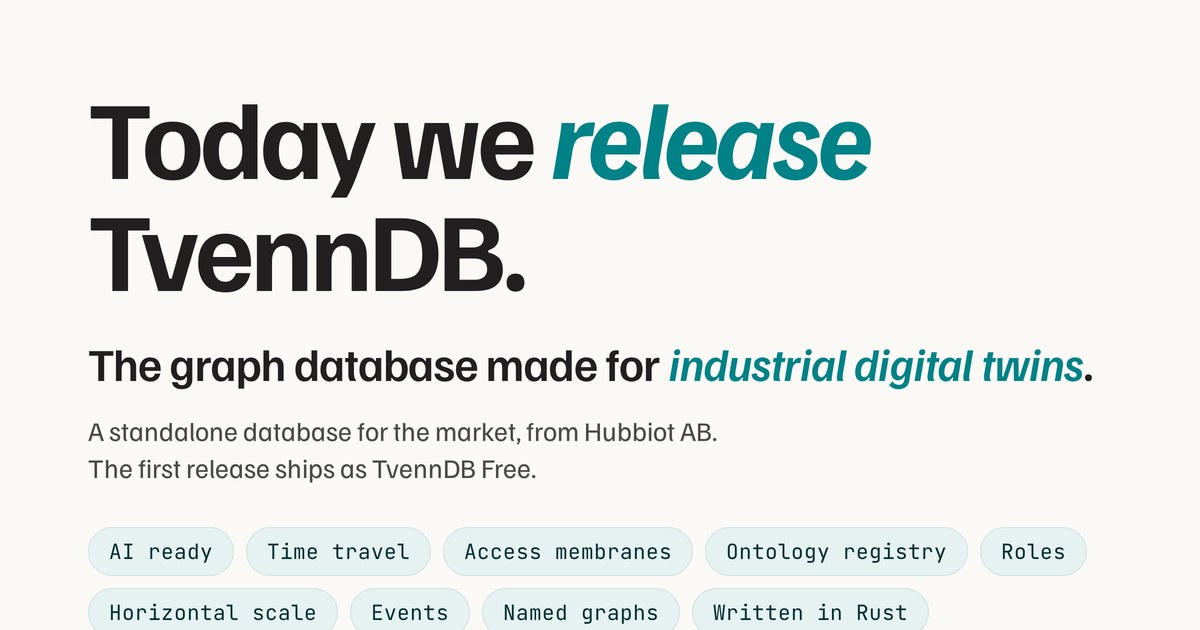
Today we release TvennDB, the graph database made for industrial digital twins. It is a standalone database for the market, from Hubbiot AB, and the first release ships as TvennDB Free.
TvennDB is a graph database for the AI era. One engine holds the structure, history and meaning of every asset, and scales out across a Kubernetes cluster as the graph grows. It is the database under Hubbiot Nexus, and from today it is available on its own.
What it brings
- AI ready. Agents connect over MCP with a credential of their own, and vector and text search feed straight into GQL.
- Time travel. Every change is kept, like git. Any query runs as of any past moment, with history, commit log and diff.
- Access membranes. Labels a principal cannot see, and subtrees it is confined to.
- Ontology registry. An ontology on every write: typed properties, keys and containment, versioned with author and message, dry run before activation.
- Roles. Read, write, schema and admin per graph, for every person, system and agent.
- Horizontal scale. Partitioned by what each asset contains, replicated with Raft, clustered on Kubernetes.
- Events. Webhooks with signatures and retries, a durable outbox and live streams.
- Named graphs. Any number of isolated graphs per cluster, each with its own ontology and history.
- Written in Rust. One static binary per process, no garbage collector pauses.
To see it at work on a small plant model, with every query as written, read Six questions an industrial twin should answer.
Get TvennDB Free
TvennDB Free is free to use, in production too. The images are built for amd64 and arm64, so the same docker pull works on a server, on Graviton and Ampere machines and on a laptop with Apple silicon, and every image and download is signed with Hubbiot AB's release key, published beside the release as release-key.pub. The repository on GitHub holds compose files, Helm values and examples for the API, Python, search and MCP:
git clone https://github.com/hubbiot/tvenndb.git && cd tvenndb/compose
cp .env.example single/.env      # set TVENNDB_ADMIN_PASSWORD
cd single && docker compose up -d
The Explorer is then at http://localhost:7000/ui/. A replicated cluster on one host and a Kubernetes install with the Helm chart are in the same repository, and the binaries, checksums and signatures are on the releases page.
This is TvennDB 1.0.0, the first release: try it, and tell us what breaks in the issues. Enterprise and SaaS editions will follow for the teams that need single sign on, audit, usage reports, online rebalancing and commercial terms.
Get TvennDB Free
Container images, a Helm chart, compose files and examples, free to use in production.
TvennDB on GitHub